/
CASE STUDIES
/
2026
/
B2B software platform
Scaling Content Output 5x for a B2B Marketing Team Without New Hires

/
OVERVIEW
Content output was expected to increase as the company entered a new market segment, but the team had no capacity to raise volume without adding headcount. The content function had no dedicated copywriter, with one content specialist handling research, writing, and publishing from end to end.

/
CHALLENGES
One person carrying every stage of content production
The marketing team's content workflow ran through three manual stages: finding ideas, writing platform-specific posts, and publishing them on a fixed schedule. Each stage depended entirely on one SMM specialist's time and attention, with no shared documentation or backup process. When that person was unavailable, the entire content calendar stalled.
Finding the right ideas took real effort
The specialist spent two to three hours a day manually checking LinkedIn, YouTube, competitor blogs, and industry sites for usable material, with notes scattered across Slack threads, browser bookmarks, and a spreadsheet only one person knew how to use.
Each idea required four to five manual rewrites
The same person who found an idea also rewrote it for every platform's format, so output quality depended entirely on how much time and attention was available that day.
Publishing relied on manual follow-up
Posts were scheduled and published manually, with no central view of what had gone live. Missed publications were often discovered only after someone checked the platform directly.
/
SOLUTIONS
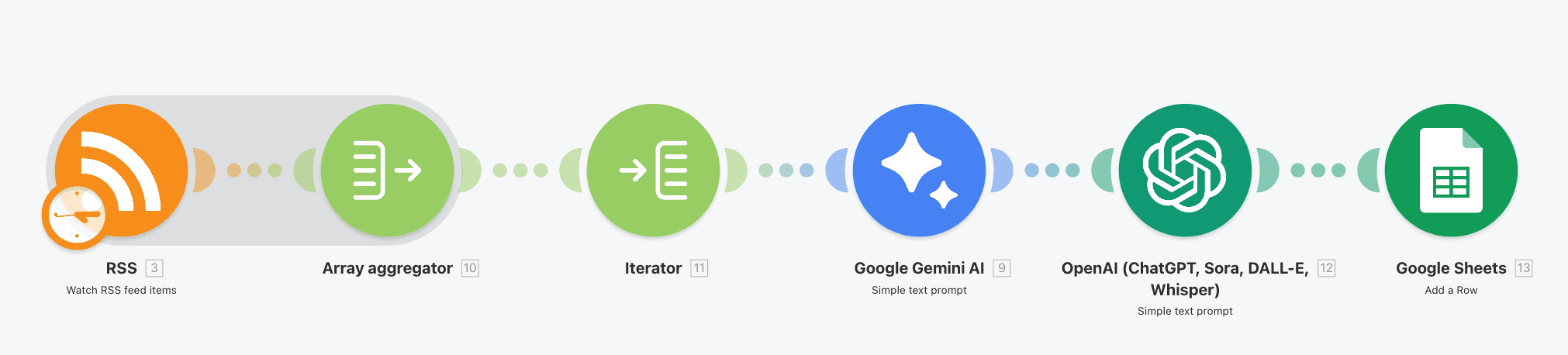
Collecting ideas automatically from RSS feeds, YouTube channels, and competitor websites
We built three connected scraping scenarios that run on a configured schedule — twice daily by default, adjustable per client need.
The RSS Feed Aggregator monitors a curated list of social media accounts and industry blogs. Each new post is scraped and analyzed for content and engagement metrics — likes, shares, and comment counts. This gives the team a live signal of what is currently getting traction in their niche, updated without anyone visiting a single feed manually.
The YouTube Content Scraper watches a defined list of target channels and playlists. When a new video appears, the scenario extracts the title, description, and timestamps, then passes the content through an AI summarization module. The team gets the substance of a video in under two minutes. Summaries are stored alongside the source link for attribution and further development.
The Website Scraper checks a maintained list of competitor blogs and industry publications on schedule. New articles are pulled, summarized, and stored with metadata: publication date, author, topic tags, and key takeaways. The result is a self-updating research library.
All scraped items land in a single ClickUp list configured as a content ideas bank. Each item carries a status field (New / In Progress / Discarded), a source tag, and an engagement score. In the morning, the team opens one ClickUp view and sees what is worth acting on.
Generating platform-adapted posts from a single idea using pre-configured AI prompts
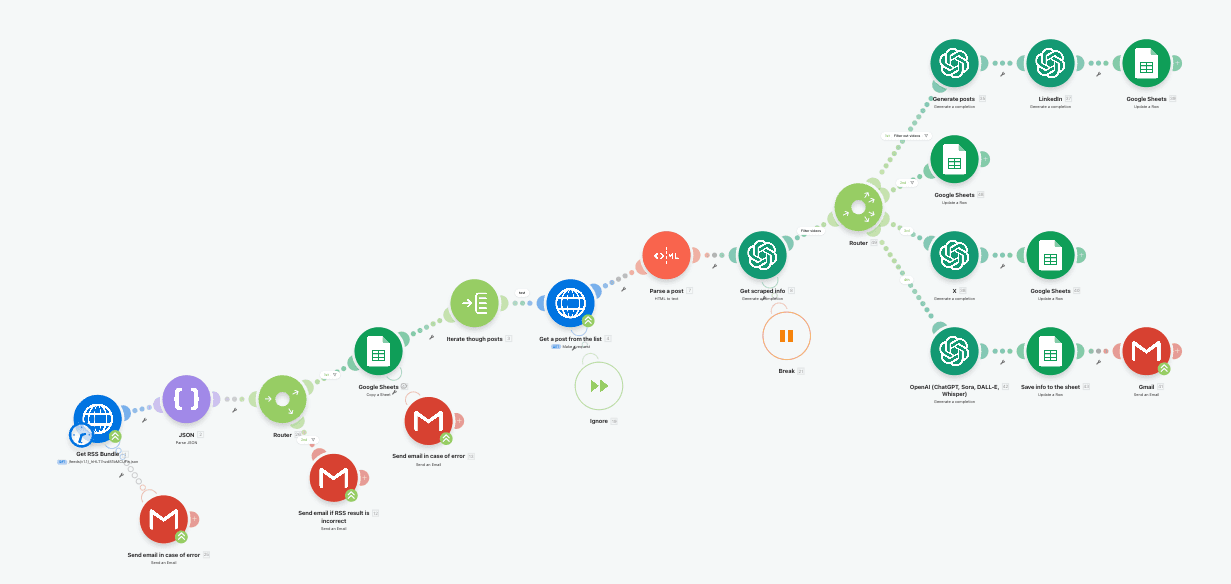
We built a generation scenario that triggers automatically when a task in the content ideas list is moved to "In Progress" status in ClickUp.
The scenario pulls the idea text and routes it to an AI module with four separate platform-specific prompt configurations: professional long-form structure for LinkedIn, two-sentence punchy format for X, conversational hook for Instagram, and a structured argument layout for Medium. Each prompt includes pre-configured parameters such as character limits, hashtag count, CTA style, and emoji usage rules, which are set once and applied consistently on every run.
The AI generates a ready-to-review post for each platform and writes each one back to the ClickUp task as a separate custom field. The task status updates automatically to "Generated." If the team wants a human review before content goes out, they move the task to "Approve"; if not, the status advances directly to "Scheduled." The full generation cycle for one idea, across four platforms, runs in under two minutes.
Each platform uses a fixed prompt setup, so the tone and style stay consistent regardless of who’s working on the content or when it’s created.
Publishing posts on schedule and tracking confirmation status in ClickUp
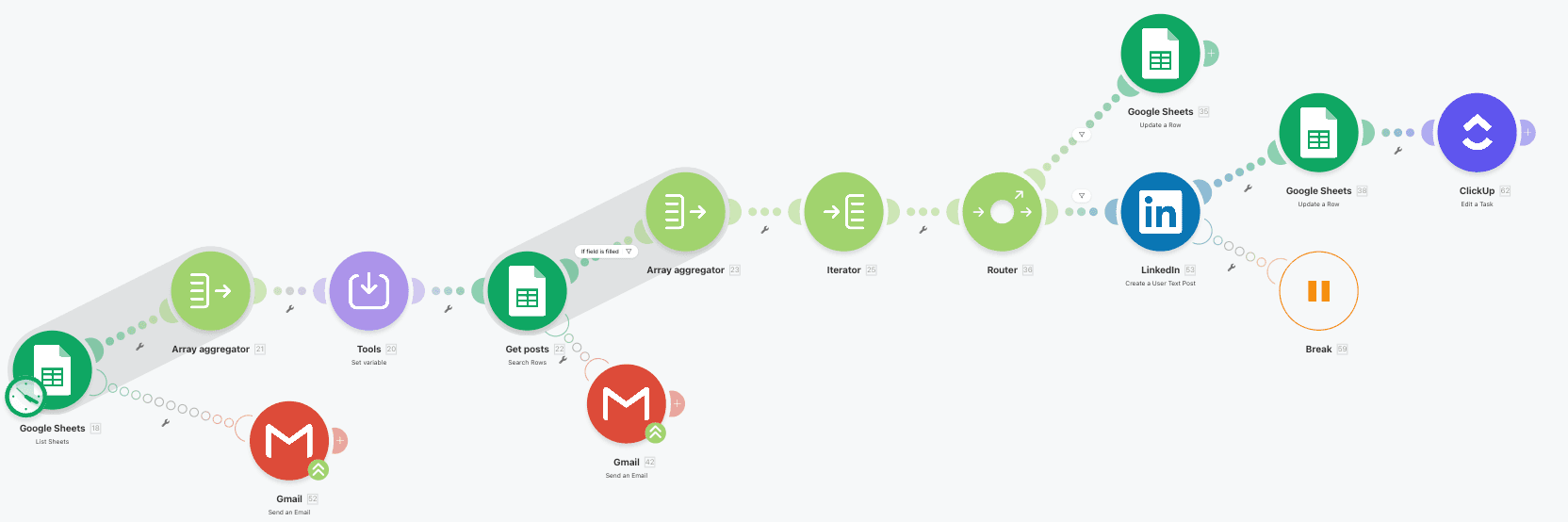
We set up a publishing scenario that runs every three hours during working hours or at peak times for each platform.
On each run, the scenario checks the list for tasks in "Scheduled" status with a publish time at or past the current time. It reads the platform-specific content field, publishes to the corresponding account, then immediately updates the task status to "Published" and sends a confirmation email with the post link and timestamp. If multiple posts are queued, the scenario works through them in order and assigns publish times automatically based on configurable spacing rules.
If a publication fails, due to an API error, an account issue, or a missing content field, the task routes to an "Error" status and an alert is sent with the specific failure reason. The team does not need to monitor platforms. A single ClickUp dashboard shows the current publishing status across all accounts in real time.
Adding a new platform to the pipeline requires configuring one new prompt template and one new publishing route. Adding a new platform does not require extra manual work per post. It simply becomes another output channel in the same flow.
/
RESULTS
Operational level
Research time dropped from two to three hours daily to under 20 minutes. Instead of switching between platforms, the team reviews a pre-populated ClickUp list with engagement data already attached. Post generation time per idea fell from three to four hours of manual writing to under two minutes.
The process is no longer dependent on one person's availability. A second team member can manage the pipeline using the ClickUp status flow alone, without knowledge of how the underlying scenarios are configured.
Business level
The team maintains consistent posting across four platforms without adding headcount. A content volume that previously required one person's full working day now runs in the background while the same person focuses on strategy, client communication, and creative direction. The pipeline is additive — expanding to a fifth platform or doubling posting frequency does not require proportionally more time.
5x
content growth
~18h
weekly time saved
100%
publishing reliability

Before this, I was basically a copy-paste machine, spending mornings hunting for ideas and afternoons writing five versions of the same post. Now I just see what the system found overnight, and move the good ones forward.

Polina
Content Specialist
/
CASE STUDIES